
The Professional Trading Routine: Prepare, Execute, Review
Professionals don't wing it. Build the three-part routine — pre-market preparation, checklist-driven execution, and the post-trade review loop — that turns scattered trades into compounding skill.
📘 The boring secret
Ask a struggling trader about their edge and you will hear about entries: a pattern, an indicator, a secret level. Ask a professional and you will hear something unglamorous: "I prepare the same way every day, I execute a checklist, I review every trade."
The difference is not intelligence — it is architecture. The struggling trader makes hundreds of improvised decisions in reactive moments; the professional made most decisions in advance, calmly, once. What remains during market hours is execution — and execution can be routinised, audited and improved.
This lesson hands you the full architecture: prepare, execute, review.
🎯 What you will learn
A 15-minute pre-market routine you can run before work.
The pre-trade checklist that filters impulse from intent.
What a complete journal entry actually contains.
The weekly review loop where improvement actually happens.
🌅 Part one: the 15-minute pre-market routine
Before the first chart-click of the day:
Calendar check (2 min). What high-impact events hit your pairs today, and when? (The fundamental lesson's ambush-prevention rule.) Mark the no-trade windows.
Mood check (3 min). Risk-on or risk-off? Three glances: equity futures, yen pairs, gold. Note one word.
Structure scan (8 min). For each pair you follow — and it should be two or three, not twenty — mark the daily and H4 structure: trend or range, nearest support and resistance zones, and the if-then for the day: "IF price retests 1.0820 and holds, THEN long per plan; otherwise nothing."
Self check (2 min). Tired? Angry about yesterday? Distracted by life? Say it out loud, write it down. Some of the cheapest trades you will ever make are the ones you skip because the pilot failed the pre-flight.
Fifteen minutes, and you now hold written intentions formed before money was on the line. Everything that happens next gets compared against them.
⚙️ Part two: checklist-driven execution
A setup appears. Before the order goes in, five questions — out loud if you must:
Is this one of my planned if-thens, or am I improvising?
Structure: does the trade align with the trend/range call from prep?
Risk: stop at the invalidation point, size from the formula, ≤1%?
Reward: honest target ≥1:1.5?
Calendar: am I about to hold through a red-flag event?
Any "no" = no trade. The checklist is deliberately dull; dull is the point. Excitement is a market emotion, and you met its price tag in the psychology lesson. When the answers are all yes: place the full ticket — entry, stop, target — and let it work without supervision-fiddling.
A trade that cannot survive five boring questions was never a trade. It was an urge with a chart attached.
📓 Part three: the journal entry
Every trade — winner, loser, or skipped setup — gets a record with three layers:
| Layer | What to capture | Why |
|---|---|---|
| Facts | Pair, direction, entry/stop/target, size, session, planned vs actual R | The audit trail — did execution match intention? |
| Context | Chart screenshot at entry, structure note, sentiment word, calendar backdrop | Future-you cannot remember today's chart; the screenshot is the time machine |
| Human | Emotion tag, rule-compliance yes/no, one honest sentence | The layer where every breakthrough hides |
By hand this takes five disciplined minutes. A connected journal collapses the facts layer to zero: link your trading account and GaphyToro logs every fill, price and time automatically — screenshots included — leaving you only the two layers that require a human: context and honesty.
🔁 Part four: the weekly review — where improvement lives
Trading skill does not compound during trades; it compounds during review. Once a week, thirty minutes, market closed:
Sort by rule-compliance first (not by profit — remember the four quadrants). What did disciplined trades earn versus undisciplined ones? For most traders this single sort is a life-changing chart.
Hunt one pattern. Best session? Worst pair? Do "rushed" tags cluster on losses? One insight per week, written down, becomes next week's single point of focus.
Grade the week's process, not its P&L. A red week of clean execution beats a green week of chaos — the green chaos is borrowed money.
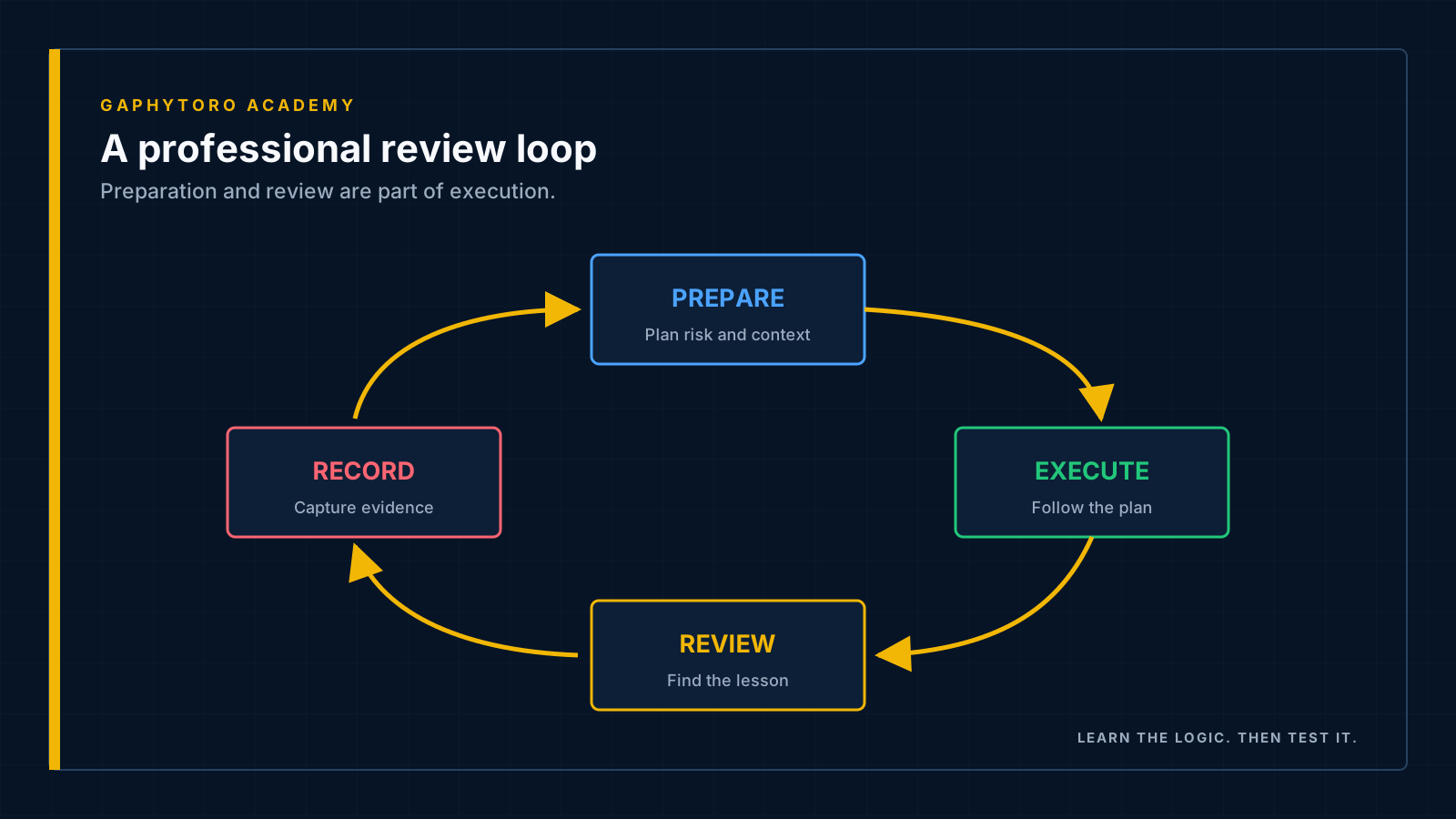
This loop — prepare, execute, record, review — is the actual job. Entries are five percent of trading; the loop is the other ninety-five, and it is the part built into GaphyToro from the ground up.
✅ Key takeaways
Professionals decide in advance; amateurs decide in the moment.
15 minutes of prep: calendar, mood, structure if-thens, self-check.
Five boring questions before every ticket; any "no" kills the trade.
Journal three layers — facts, context, human. Automate the facts; be honest in the rest.
Weekly review sorted by rule-compliance is where skill actually compounds.
⏭️ Coming up next
You have a routine. Now for what fills it: what a complete trading strategy actually contains — and why "moving-average crossover" is an ingredient, not a recipe.