
What Makes a Real Trading Strategy (Hint: Not an Indicator)
"Buy when the lines cross" is not a strategy — it's an ingredient. Learn the eight components every complete strategy specifies, see them assembled into a worked example, and test any method with the stranger test.
📘 The recipe problem
Ask a beginner for their strategy and you will usually hear an ingredient: "I buy when RSI is oversold" or "moving-average crossover". That is not a strategy — that is flour claiming to be a cake.
A strategy is a complete recipe: what to trade, when to trade it, exactly where you are wrong, exactly where you take profit, how much to risk, and when the recipe should not be used at all. Complete means a stranger could follow it and take the same trades you would. Anything less is improvisation with extra steps.
🎯 What you will learn
Strategy vs setup vs signal vs random idea — the taxonomy.
The eight components every complete strategy specifies.
A fully assembled example strategy, component by component.
The stranger test — the one-question completeness check.
🧬 The taxonomy
| Term | What it is | Example |
|---|---|---|
| Signal | A single observation | "RSI just crossed 30" |
| Setup | A recognisable market condition combining signals with structure | "Uptrend pullback to support with a rejection wick" |
| Strategy | Setup + entry/exit/risk/filter rules, fully specified | The complete recipe below |
| Random idea | An urge with a chart attached | "EUR/USD feels toppy, I'm shorting" |
Signals feed setups; setups anchor strategies. Most beginner "strategies" are naked signals — which is why they cannot be tested, improved or trusted under pressure.
🧩 The eight components
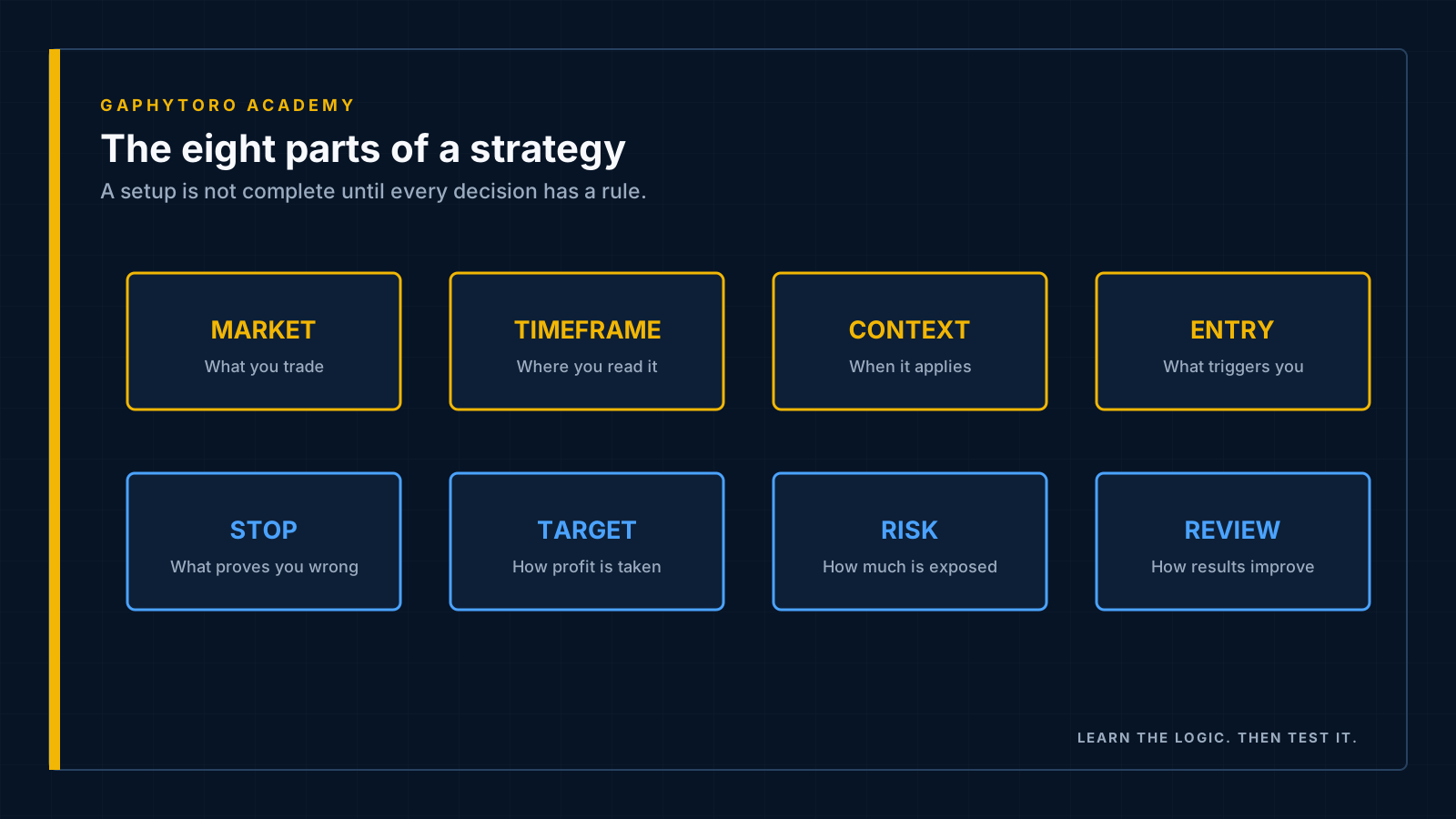
1. Market selection. Which pairs, exactly? (Two or three majors beats twenty tabs.)
2. Timeframe. Where do you analyse, where do you execute? (E.g. structure on H4, entries on H1.)
3. Setup definition. What must the market look like before you are even interested? This is the trend/range/level language from the technical lessons.
4. Entry trigger. The specific event that converts interest into an order — a close beyond a level, a rejection at a zone. Specific enough that yes/no is never a debate.
5. Stop-loss rule. Where is the idea provably dead? Placed by structure, sanity-checked by ATR.
6. Target rule. Where do you take profit, and does it clear the minimum risk-reward bar?
7. Risk allocation. Percent per trade, from the sizing formula. Non-negotiable.
8. Filters — when NOT to trade. Red-flag news windows, dead-zone hours, days after the circuit breaker fires. Professionals define the "no" conditions as precisely as the "yes".
🍰 The recipe, assembled
Here is a complete beginner-grade strategy using only ingredients this course has taught. (For education — not a recommendation; its job is to show what complete looks like.)
"London Pullback" — trend-following
1. Markets: EUR/USD, GBP/USD only. 2. Timeframes: trend on H4, execution on H1. 3. Setup: H4 in a clear uptrend (higher highs + higher lows); price pulling back to a marked H4 support zone during London hours. 4. Trigger: an H1 candle closes bullish with a lower-wick rejection inside the zone. 5. Stop: below the zone's far edge, minimum 1× ATR(14) from entry. 6. Target: the most recent H4 swing high; skip the trade if that offers less than 1:1.5. 7. Risk: 1% per trade via the sizing formula; max two open trades, never both long the same currency. 8. Filters: no entries within 60 minutes of red-flag events on either currency; no trades in the dead zone; no trades the day after a daily circuit-breaker.
Every component answers a question a stranger would otherwise have to guess. That is the test, and it is worth naming:
The stranger test: could a competent stranger, given only your written rules, take the same trades you would this week? If not, you do not yet have a strategy — you have a mood.
🔍 Why completeness is the whole game
A complete strategy gives you three superpowers a naked signal never can:
It can be tested. Next module you will demo-trade a strategy and collect real statistics — impossible when the rules live in your mood.
It can be audited. When results disappoint, your journal can isolate which component leaked: were the losses rule-breaks (a discipline problem) or rule-followers (a strategy problem)? Different diseases, different medicine — indistinguishable without written rules.
It can be improved. One component changed at a time, results compared. This is the engineering loop that the expectancy lesson will formalise next.
✅ Key takeaways
Signal → setup → strategy; most beginner "strategies" are naked signals.
Eight components: markets, timeframes, setup, trigger, stop, target, risk, filters.
Filters — the "when not to trade" rules — are as load-bearing as entries.
The stranger test is the completeness bar: written rules a stranger could follow.
Complete strategies can be tested, audited and improved; moods cannot.
⏭️ Coming up next
You know what a strategy is. Next: the mathematics that decides whether it deserves your money — win rate, risk-reward and expectancy, including why a 40% win rate can beat a 70% one.