
The Readiness Check: Graduating from Beginner
The honest self-assessment that decides your next step: consolidate, re-run the gauntlet, or advance. Plus the map of what intermediate training holds — backtesting, multi-timeframe analysis, trade management and strategy statistics.
📘 The graduation question
Nineteen modules ago, forex was a word from YouTube ads. Now you read pairs fluently, size positions from a formula, plan trades as if-thens, and — if you ran the gauntlet — own twenty journaled trades of evidence about who you are under pressure.
One question remains, and only you can answer it honestly: are you ready for what comes next? This lesson is the mirror. No sales pitch, no hurry — markets have a decades-long habit of still being there tomorrow.
🧭 The 12-point readiness check
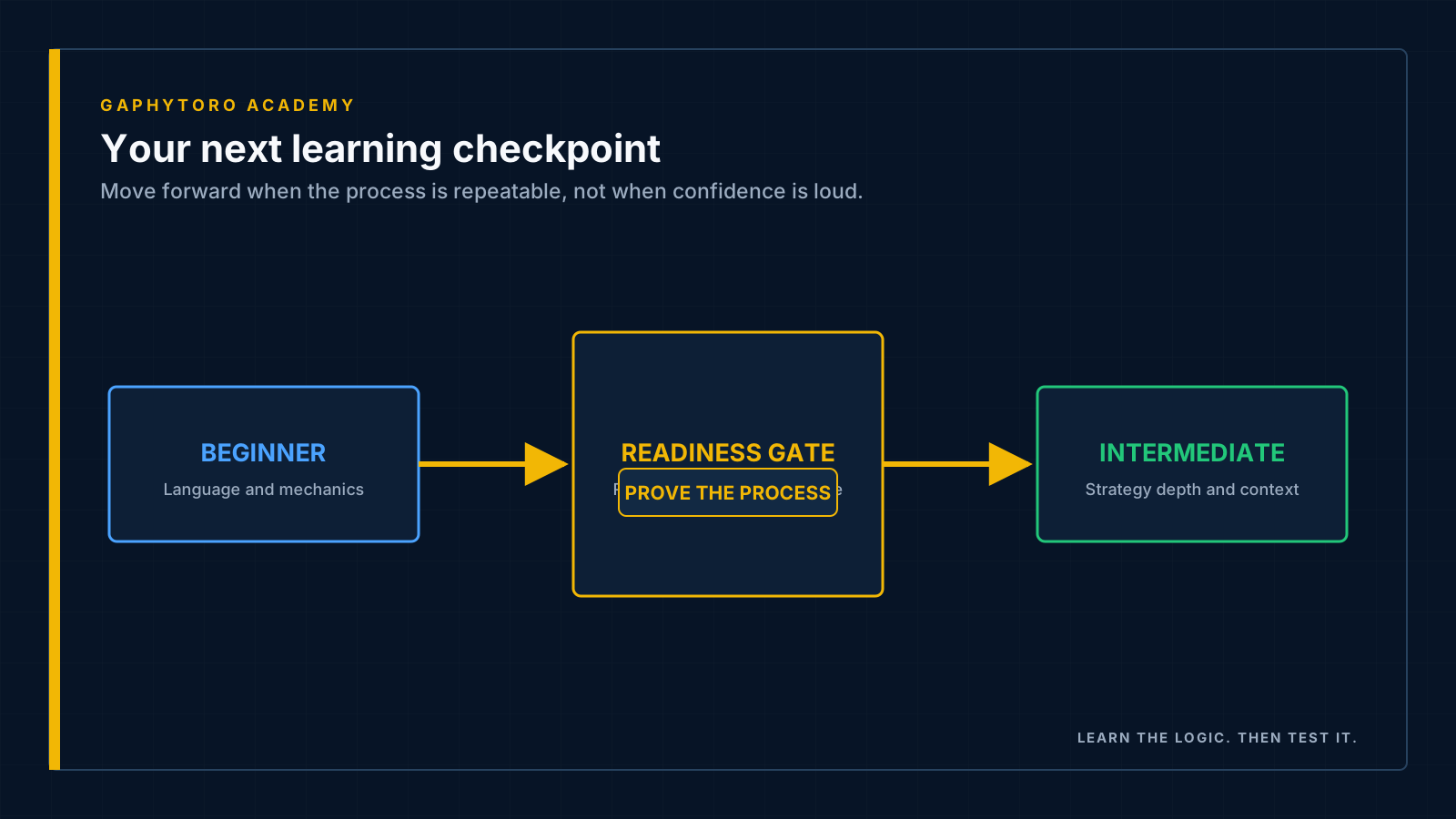
Answer each honestly. Your journal — not your memory — is the witness for the final four.
Knowledge (can you explain it to a friend?)
1. Why a currency pair's price is a relationship, and what long/short each profit from.
2. Pip values and lot sizes — computing a position size with the formula, unaided.
3. Margin, free margin, margin level — and the story of how a stop-out happens.
4. Limit vs stop orders, and where SL/TP belong relative to structure.
5. The data → central bank → rate expectations → flows chain.
6. Expectancy, and why win rate alone is meaningless.
Skills (have you done it, repeatedly?)
7. Marked structure (trend/range, zones) on a fresh chart in under ten minutes.
8. Run the full pre-market routine for at least four consecutive weeks.
9. Placed complete tickets — entry, stop, target, correct size — without mechanical errors.
Evidence (does your journal prove it?)
10. Twenty-plus journaled demo trades with ≥90% rule compliance.
11. At least one losing streak survived without a breaker violation or size change.
12. Weekly reviews written for a month, each naming one pattern found in your own data.
Scoring: 12 yeses — advance with confidence. 9–11 — close: spend two more weeks on the gaps (usually the evidence section) and re-check. Under 9 — the kindest move is repeating the gauntlet; advancing on a shaky foundation costs far more later than a month of consolidation costs now. There is no prize for arriving early, only for arriving intact.
Trading rewards the prepared, not the fast. Every month spent consolidating basics is repaid with interest by every year that follows.
🗺️ What intermediate training holds
When the checklist says go, here is the terrain ahead:
Strategy construction and backtesting — building your own eight-component strategies and testing them against historical data before risking a cent, then forward testing to confirm the edge survives live conditions.
Multi-timeframe analysis — reading weekly, daily and hourly structure as one coherent story instead of three arguments.
Trade management — the arts of the middle: partial exits, breakeven moves, trailing stops, and when each helps versus quietly bleeds expectancy.
Strategy statistics at depth — profit factor, maximum drawdown, equity-curve health, and reading your own numbers the way a fund manager would.
Live-transition protocol — the deliberately small first live account, and managing the emotional difference real money makes (it is larger than everyone expects).
Some graduates also eye prop-firm evaluations — trading a firm's capital after passing their rules-based challenge. Everything this course drilled (fixed risk, breakers, process grades) happens to be exactly what those evaluations test; the intermediate course covers them properly.
🧰 Your permanent toolkit
Whatever path you take, three habits from this course are now permanent equipment:
The routine — prepare, execute, record, review. It scales from beginner to professional unchanged.
The math — 1% risk, formula sizing, expectancy thinking. Non-negotiable at every level.
The record — your journal is your career's memory, your coach and your audit trail. Keep it connected, keep it honest, and let your analytics tell you truths your memory would rather edit. If you've made it this far without one: start free — your intermediate self will inherit the data.
🏁 A closing word
Most people who "try forex" never learn what you now know. They arrive chasing signals, meet leverage uninstructed, and depart within months, convinced the market is rigged. You took the other road: mechanics before money, process before profit, evidence before confidence.
The market will still test you — that is its job. But you are no longer walking in unarmed. See you in the intermediate course. 🎓
✅ Key takeaways
Advance on 12 honest yeses; consolidate on fewer — the journal is the witness.
Repeating the gauntlet is a professional move, not a failure.
Intermediate = backtesting, multi-timeframe reading, trade management, deep statistics, live transition.
Routine, math and record are permanent equipment at every level.
Slow is smooth; smooth is fast. The market will wait.