
Forex Market Hours: When to Trade and When to Sleep
Forex never sleeps — but it definitely naps. Learn the Sydney, Tokyo, London and New York sessions, why the London–New York overlap is prime time, and how to pick a trading window that fits your actual life.
📘 The market that follows the sun
Forex is open 24 hours a day, five days a week — but not because one exchange stays awake. Remember: there is no exchange. Instead, the trading day follows the sun. As banks in one financial centre head home, banks in the next time zone are switching their screens on. Sydney hands to Tokyo, Tokyo to London, London to New York, and New York — late on Friday — finally switches off the lights for the weekend.
"Always open" does not mean "always worth trading". The market has a daily heartbeat: hours when it sprints and hours when it snoozes. Learning that rhythm is free edge — one of the few advantages that costs nothing but attention.
🎯 What you will learn
The three major sessions and their personalities.
Why the London–New York overlap is the market's rush hour.
How liquidity and spreads breathe through the day.
How to choose a trading window that fits your life — not fight it.
🌏 The three sessions and their personalities
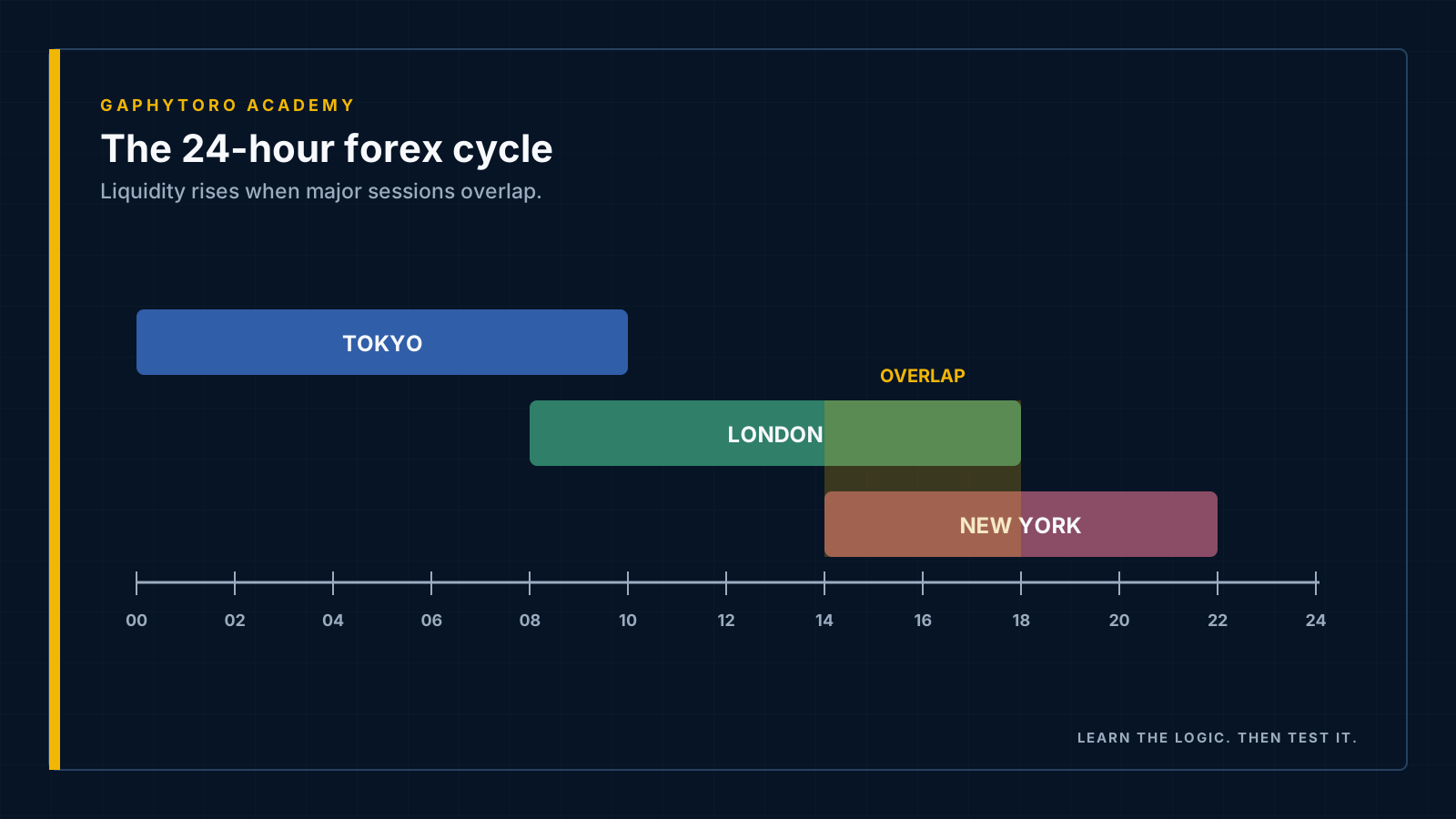
| Session | Approx (GMT) | Personality | Most alive |
|---|---|---|---|
| Asian (Tokyo) | 00:00–09:00 | Calm, rangebound, methodical — the market stretching | JPY and AUD pairs |
| London | 08:00–17:00 | The heavyweight — largest share of daily volume, real trends start here | EUR, GBP, CHF pairs |
| New York | 13:00–22:00 | Energetic, news-driven — US data lands in its morning | USD pairs, gold |
(Exact hours shift with daylight saving; your platform clock and an economic calendar will keep you honest.)
The golden overlap
From roughly 13:00 to 17:00 GMT, London and New York are both fully staffed. This four-hour window is the market's rush hour: the deepest liquidity of the day, the tightest spreads, and the moves with the most follow-through. If you can only trade a few hours, professionals will almost universally point you here — or at the London open.
The flip side: the dead zone. After New York closes and before Tokyo fully wakes (roughly 21:00–00:00 GMT), liquidity thins dramatically. Spreads widen, price drifts aimlessly, and small orders push price around in fake-looking jerks. Beautiful setups formed in the dead zone have a habit of dissolving at the London open.
Liquidity is not just about cost — it is about meaning. A move made on deep liquidity reflects real conviction from serious money. The same move in a thin market reflects almost nothing.
📅 One day in the life of EUR/USD
Tokyo hours: EUR/USD dozes in a 15-pip range. Yen pairs are having their day; the euro is mostly waiting.
08:00 London open: volume floods in. Yesterday's range breaks; the day's real direction begins to express itself.
13:30 US data drop: a jobs report hits. One sharp spike, spreads flare for a minute, then the London–NY overlap digests the number and picks the trend for the afternoon.
17:00 London goes home: energy fades. New York winds the day down.
21:00+: the dead zone. The chart breathes shallowly until Asia stirs again.
Not every day follows the script — but enough do that session context belongs in every trade note you write.
🧭 Choosing YOUR window
Here is the honest part most courses skip: the best session is the one your actual life allows you to trade with a clear head.
Free mornings (East Africa / Europe time)? The London open is your natural habitat.
Free afternoons and evenings? The overlap and the New York session fit beautifully.
Only late nights? Consider the calmer Asian session and range-based approaches — or slower swing trading that does not need session-watching at all.
A tired trader in the perfect session loses to a rested trader in a mediocre one. Consistency of window also does something subtle: it makes your results comparable. Fifty trades taken in the same session teach you something; fifty trades scattered across all hours are statistical soup.
When you journal, tag every trade with its session. After a month, your analytics will answer a question you cannot answer today: when are you actually good? Many traders discover their London-open brilliance funds their New York-afternoon leaks — a pattern invisible without a journal that tracks time-of-day performance.
✅ Key takeaways
The trading day follows the sun: Tokyo → London → New York, every weekday.
London is the volume heavyweight; the London–NY overlap (≈13:00–17:00 GMT) is prime time.
Thin markets (the dead zone) mean wide spreads and meaningless moves.
Pick one window your life supports, trade it consistently, and tag it in your journal.
Session context turns identical-looking setups into very different trades.
⏭️ Coming up next
You know when to look at the market. Time to learn what you're looking at: candlestick charts — the four-number story every candle tells, and why traders read them like sentences.