The yen has stabilized, but the pressure has not disappeared.
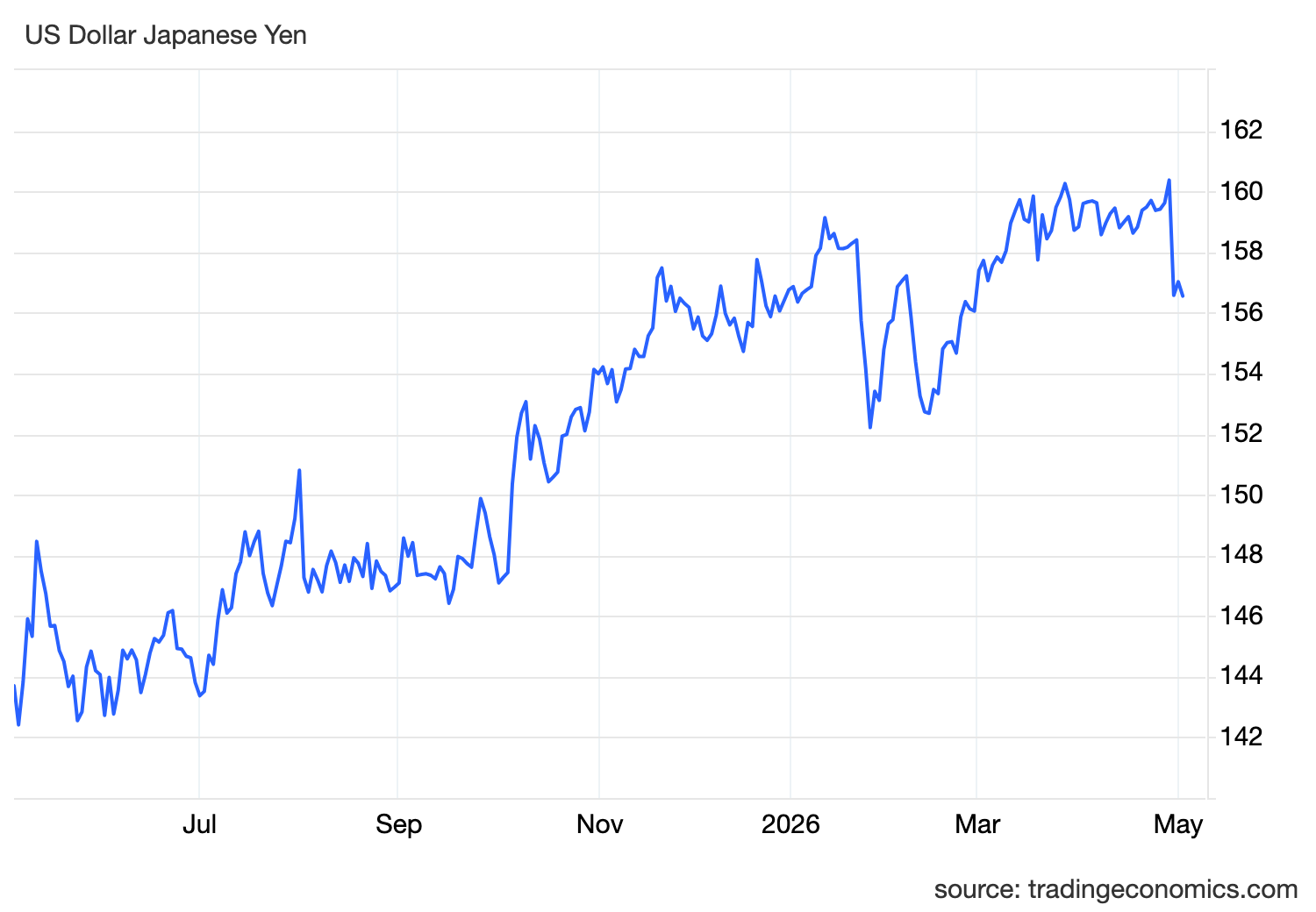
Dollar yen holding near 157 tells us one thing clearly. Markets are no longer trading this pair purely on rates. They are also trading the risk of official action.
Last week’s move was the warning shot.
After dollar yen pushed beyond the 160 level, the yen suddenly rallied as much as 3 percent to around 155.5. Japanese officials did not confirm intervention, but the price action looked like classic official support.
Fast. Sharp. Timed around a key psychological level.
That matters because 160 is no longer just a chart level. It is now a policy level.
Tokyo has a history of stepping in when yen weakness becomes too disorderly, especially when moves threaten import costs and household inflation. A weaker yen makes energy and food imports more expensive, which becomes politically and economically difficult when inflation is already sensitive.
So the logic is clear.
Yen weakness raises import inflation. Import inflation pressures households. Political pressure rises. Intervention risk increases.
That is why traders are now alert for more rounds of yen buying.
Intervention is rarely treated as a one-time event. If authorities step in once, markets usually assume they may follow through again, especially during thin liquidity periods when intervention can have a larger impact.
Holiday trading conditions make that risk even sharper.
The bigger issue, however, is that intervention does not fix the underlying macro problem.
The Bank of Japan kept rates unchanged. The Federal Reserve also held steady. That preserves the wide US and Japan rate gap, which remains the main reason dollar yen is supported.
US yields are still attractive relative to Japan. That keeps carry demand alive. As long as investors can earn more holding dollars than yen, the structural pressure on the yen remains.
This is where the policy tension becomes obvious.
Japan can slow the move through intervention, but it cannot fully reverse the trend unless the rate gap narrows.
That would require either the Fed to turn more dovish, the Bank of Japan to tighten more aggressively, or both.
For now, neither side has fully delivered that shift.
So the yen is caught between two forces.
On one side, intervention risk limits aggressive dollar yen upside. On the other side, rate differentials continue to support the dollar.
That makes the market unstable.
Dollar yen can fall quickly if Tokyo steps in again. But without a deeper policy shift, buyers may return once the intervention pressure fades.
The key takeaway is simple.
Japan may be defending the yen, but the macro backdrop is still working against it.
Filed under
Written by

Founder & CEO, GaphyToro
Philip Ogina is the Founder and CEO of GaphyToro, a trader-first performance ecosystem built to help modern traders improve through structure, discipline, data, and better execution. He is a trader, investor, market analyst, educator, and software builder focused on building tools and infrastructure for the next generation of traders.